Here's How To Go From Hair Coming Out Everywhere To Long Hair Again, With 3 Things From Your Kitchen, In 12 Weeks
While also settling an itchy, dry scalp, costing less than one jar off that shelf, and taking about 20 minutes across a whole week.

What is The Kitchen Method?
The Kitchen Method is how your hair gets long when it hasn't in years. 3 things out of your own kitchen, on set days, for 12 weeks.
Your ends stop snapping off, so the growth you've had all along finally stays on your head. There's less on the comb and less on the pillowcase, and the itching settles down.
Everything you need is on a grocery shelf, not at the beauty supply. No salon chair, and you keep the styles you like.
Here's the backwards part. The rest of the week, you leave your hair alone. No greasing it every night, no combing it through twice a day, none of that constant working on it we were all raised to do.
So you can stop hunting the next remedy and go back to just having hair instead of managing it.
That's The Kitchen Method.
The Kitchen Method is a shortcut
For 40 years I did exactly what I'd been taught, same as my mother did, and hers before her.
Grease on the scalp every night. The comb through it morning and evening. Sunday pressing, the wrap at bedtime, and whatever was new on the shelf at the beauty supply that month, because if it was new it had to be better.
And my hair sat right at my collarbone from the time I was 34 until I was 61. By my fifties it was coming away in the comb every single morning.
Then one afternoon I asked a woman named Bernice what she used on hers. She did hair in her own kitchen, and at 70 she wore a plait down past her shoulder blades.
“Baby, it's not what I put on it. It's that I leave it alone.”
So I went home and looked at what was in my comb instead of rinsing it out. Short little pieces. Broken bits with no root on the end of them.
My hair wasn't falling out, child, it was snapping off halfway up, and it had been doing that quietly for 20 years. It had never once stopped growing. It just wasn't staying.
I stopped nearly all of it. Kept 3 things from the kitchen, put them on set days, and left the rest alone the way Bernice said.
That was 7 years ago. I wear mine short now because I like it short, and that comb's been clean ever since.
Now you can run the same 12 weeks I run, in a $27 book called The Kitchen Method.
The Kitchen Method, plus all 4 gifts




Here's How I Went From Losing It Every Single Morning To A Head Of Hair That Stays Where It Belongs, By Ignoring Nearly Everything I Was Taught About Taking Care Of It
Read the story below and you'll see where all that hair was actually going.
Would it surprise you to hear that I'm 68 and I still have every bit of my hair, after 10 years of watching it come away in the comb every morning, using nothing but 3 things I buy at the grocery store and everything else that's written in this 128 page book?
You ought to be skeptical. Lord knows enough has been sold to women our age, and most of us have paid for some of it twice.
So let me show you
First, though, let me say something plain, because it matters more than anything else on this page.
I'm no doctor, and this book doesn't diagnose anybody or treat anything. What I've got is 40 years of doing my own hair and half the neighborhood's, 7 years of doing it a completely different way, and a stack of research I paid a young woman to sit down and go through with me properly.
Now. There's a condition some women have that scars the follicle shut. Where that's happened, no oil and no rinse and no cream and no amount of praying is bringing that hair back, and I'm not going to pretend otherwise.
The book tells you the signs of it in plain words and tells you to go get seen. I put it in the front instead of the back, because it's worth more than anything else I could sell you.
And what any of us gets out of 12 weeks depends on what's really going on up there, how long it's been going on, and whether we do the weeks or just read about them.
With all that said, let me show you what I found.
And I Did It By Leaving My Hair Alone, Which Is The Last Thing Anybody Ever Told Me To Do, And I'm Going To Show You The Whole Of It Right Here
The same Kitchen Method that women all over the country are running now to get length on hair that hasn't grown longer in years.
Which also means no more standing in that aisle on a Saturday spending money on jars that end up under the sink with the rest of them.
And their wash day back down to something that fits in an afternoon, instead of eating the whole thing.
Best of all, no covering it up, no explaining it to anybody, and no more apologizing for your own head.
Just Like Gloria, Who Finished Her 12 Weeks A While Back
“I've worn the same headband to church for 9 years so nobody could see the front of my head. I'm not wearing it Sunday. That's all I'm going to say about it.”
The length is what she noticed first, but that's not the best part of it.
The best part was her Saturdays.
Gloria had been handing most of a Saturday over to her hair every week for years. Washing, sitting under that dryer, greasing, sectioning, wrapping, the whole business. She's down to about an hour now, and her hair is doing better on that hour than it ever did on 6. She's got her Saturdays back.
She's not the only one, either.
This Is Doretha, Who Came To It After 50 Years Of Doing It The Other Way
“The thing nobody warned me about is how much of it was the comb. I've been fighting my own hair with a rat tail comb since 1974 and calling it grooming. 12 weeks of doing what the book said and my ends are still sitting there.”
And Yvonne, Who Nearly Didn't Buy It At All
“I told my daughter I wasn't spending another dollar on my hair after a trichologist took $2,000 off me and handed me a bottle. I only bought this because it cost less than lunch. What got me was the page on what to ask the doctor. I'd been asking all the wrong things for years and nobody corrected me.”
Gloria, Doretha and Yvonne are 3 out of more than 2,000 women now doing this backwards from how we were all raised.
And you can bet on this much.
The Kitchen Method isn't like anything else being sold to us right now, because…
Truth be told, we hardly touch our hair at all between the days the book tells us to.
We do 3 small things on set days and then leave it completely alone.
This really is different, and I know it because it changed everything for me.
The Kitchen Method Got Rid Of Nearly Everything I Hated About Hair
Here's What My Life Used To Look Like
I call it the Wash Day Loop, and I ran it for 20 years.
That loop kept me busy for 20 years and left me with hair that hadn't moved past my collarbone since I was 34.
By about 2018 I'd given the whole thing up. I'd decided this was simply what happens to us, and I bought myself a headband and made my peace with it.
But before I let it go for good, I wanted to try one thing.
Something that, if it worked, would change how I looked at all of it.
And it worked.
Then I spent years turning it into something a woman can follow without having to think about it.
And I Put The Whole Thing In A 128 Page Book Called The Kitchen Method, And You Can Start Reading It A Few Minutes From Now
Before you do, let me tell you how any of this came about.
My name's Janet.
You probably haven't heard it, and that's on purpose. I'm not on camera and I'm not going to be. I'd rather you look at your own head than at mine.
I'm 68. I've been doing hair, mine and everybody else's, since I was old enough to hold a comb without dropping it.
Let me tell you where I was in the spring of 2019.
There's a notion out there that if you take care of your hair, it'll take care of you.
Well. Sometimes it doesn't.
And if what you're after is length, doing more to it is almost never the answer.
I know, because I tried. Faithfully, for 40 years, I did everything the women before me did, and everything the shelf told me to do on top of it.
I Ended Up With Hair That Hadn't Moved In 27 Years, And I Hated It
I hated it because I'd done everything right.
I wasn't careless with my hair. I wasn't one of those women who let herself go. I put more hours into that head than into anything else I own, and it went backwards on me anyway, and it made me feel like a fool in my own bathroom.
So I did what everybody does. I went looking for a way out.
Took me months, and I found it in a place I never would have thought to look.
Bernice Never Bought A Product In Her Life
I told you about Bernice already. Let me tell you the rest of it, because that one afternoon is the reason this book exists.
Bernice was 70 when I knew her. She'd done hair out of her own kitchen on Saturdays for 30-odd years, the same 2 chairs and the same kettle, and she never once had a shelf of anything. She had a jar, a comb she'd had longer than my marriage, and that was the whole operation.
When she said it wasn't what she put on it, I thought she was being modest. Women that age often are.
But she wasn't finished.
“You girls comb your hair to death. You comb it in the morning, you comb it at night, you comb it when you're worried about something. Then you wonder where it went.”
I sat with that all the way home.
Then I got to reading, and what I found made me angrier than anything Bernice said.
Nothing They Ever Sold Us Was Made For Us
Every last thing on that shelf is sold on the promise of growth. So I went looking for what any of it was actually built on.
The one medicine that genuinely works on women, the one with real evidence behind it, was tested in a study that enrolled women aged 18 to 49. Not one woman my age was in it. Not one.
Those laser caps they advertise to us, the ones running $600 and $700 and $1,200? Every single one of them is cleared by the FDA for skin types 1 through 4. Ours are 5 and 6. That exclusion is written in the paperwork, in plain English, and not one of those companies puts it in the advertisement.

And of the 16 natural ingredients everybody in the world talks about for hair, there isn't one that's ever been tested on a Black woman, or on anybody over 65.
Then there's the condition that hits women our age hardest, the one that starts at the crown and spreads out. Not a single completed study of any treatment for it. Not one.
So for 40 years I stood in that aisle picking things up and putting them back, thinking the problem was me.
Child, there was never a thing wrong with my hair.
And Then I Found The Young Women
Somewhere in all that reading I came across a whole crowd of young women online, half my age, going back and forth about something they called retention.
Not one of them was talking about growth. They'd worked out, on their own, without any of us telling them, that the growing takes care of itself. What they were tracking was how much of it survived the week.
Every one of them had our texture. Same shrinkage, same dryness, same wash day, same everything.
The only difference between them and me was where they'd put their attention. They weren't trying to make hair appear. They were trying to stop what they had from breaking off, and they were keeping notes on it like a science project.
Bernice had told me the same thing in 9 words, 40 years earlier, and I'd needed a room full of 28-year-olds to make me hear it.
That Idea Is The Most Sensible Thing I've Come Across In 40 Years Of Doing Hair
Sit with it a minute.
Now, those young women were building all this around braid takedowns and protective styles and products aimed at a woman of 28. I needed something that worked for a woman with a hip that talks to her in the morning, a scalp that starts itching a few days after wash day, and a grocery budget.
And here's the part that pulled me in.
You don't have to do more.
The whole thing gets easier instead of harder, which at our age is the only kind of advice worth taking.
All you do is stop the wear, and put a few cheap things on the shaft so it holds up better between wash days.
Which Brings Me To The Break Line
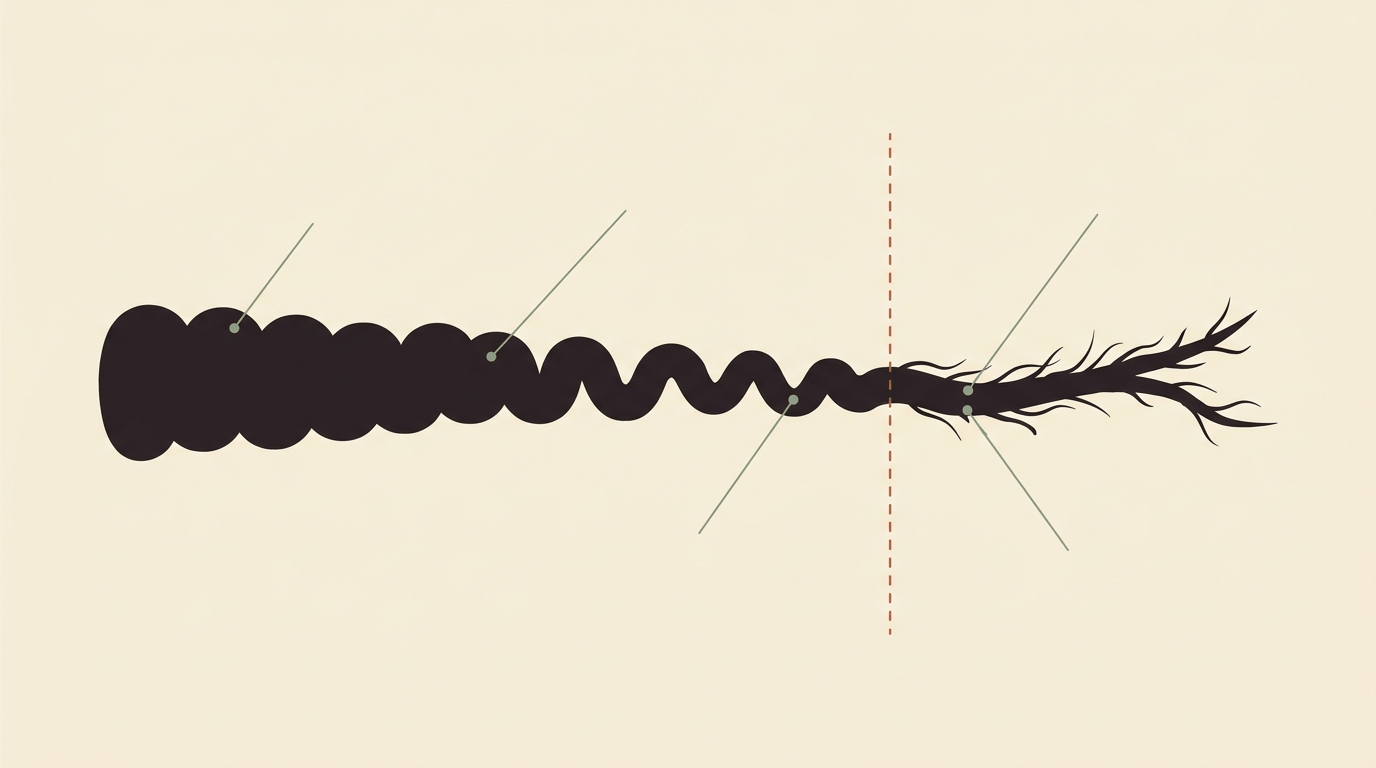
Every head has a place along the strand where the hair gives out. Everything closer to the scalp holds fine. Everything past it snaps.
I call it the break line, and once you've seen it you can't unsee it. It's why so many of us have hair that's all one length without ever having cut it that way.
3 things decide where that line sits. One is friction, and that's the comb, the towel, the pillow and the wrap.
Another is tension, meaning anything that pulls, and yes, that takes in the styles we wear to hide the thinning.
The last one is how dry and brittle that shaft has gone by the time the next wash day comes around. That's the part the kitchen handles.
Push that line further out and the length you're already growing finally starts showing up.
And That's Where All This Started
After a good bit of reading I started keeping notes on my own head like a woman keeping a farm ledger.
Half of it meant nothing to me at first. Which oils sit on top and which ones go in. How often is too often. What actually needs diluting and by how much. The difference between a hair that shed and a hair that broke, which I'd never once looked at in 40 years.
All I really knew how to do was pay attention and do the same thing long enough to tell whether it did anything at all.
Those first 2 years were slow going. A lot of guessing, and money I'd rather not add up. There was one whole autumn where I made my own scalp worse with something everybody swore was gentle, and it took me months to work out it was the very thing I kept putting on it.
I did what the young women said, and a good deal of it worked beautifully. But their whole way of doing things assumed 4 hours on a Sunday and a pair of arms that reach behind your head without complaining, and by the end of it I had a routine I couldn't actually keep.
That's when I nearly quit the second time.
Thank the Lord I didn't.
That Was 7 Years Ago, And Today It Almost Seems Like A Bad Dream
I proved that whole notion of taking care of your hair wrong, at least the way I was taught it.
Where I used to give up a full Saturday, a shelf of half-used jars and a comb full of my own hair every morning, I do 3 small things on set days and let it be. That comb's been clean for 7 years.
Most of what gets sold to women our age asks you to add something to your day. This takes things off it.
You know what most women our age end up spending their attention on? Managing the thing, and hiding it, and picking a style that covers the front, and working out whether the light in somebody's living room is going to show the part.
I did that for years. It wore me down, and it made the whole thing worse, because nearly every way of hiding it pulls on the very hair you're hiding.
I didn't have hair. I had a daily project.
Want To Know The Main Difference Between The Kitchen Method And The Old Way?
The old way is spent trying to make hair appear. The Kitchen Method is spent making sure what you're already growing stays on your head long enough for somebody to notice it.
Instead of everything I listed above, here's my week now.
And what came of doing it that way?
Ends that are still sitting there 3 months on, that used to be gone by week 3.
Which Naturally Leads To
Hair that goes up without the front giving way, and comes down again without half of it staying in the comb.
And there's what you can do with it once there's enough of it. A bun that doesn't need a piece put in it, a plait you did yourself, or a grandbaby with her hands in it while you're trying to watch your program.
And the part I never expected at all was my scalp. That itch that used to turn up a few days after every wash day is simply gone, and I wasn't even looking for that one.
Follow every step in the book and you end up keeping your length.
But it's more than that.
It's knowing where you stand, which is a whole different feeling from hoping, and for a lot of women it'll be the first straight answer anybody has given them about their own head in 10 years.
How many hair remedies have you watched come and go?
Women rubbing oil into the scalp every night for a solid year and wondering why nothing changed. Or taking a supplement that's never once been tested on anybody who looks like us. Or buying a device that was never tested on our skin type at all, which is the one that still makes me angry.
I've been running this method 7 years straight now.
Bernice ran hers for 30 years on a jar and a comb, and it worked the same in her last year as it did in her first, because there was nothing in it to discontinue.
Nothing here can be discontinued, or pulled off the shelf, or priced out of your reach. It's a grocery store, and grocery stores don't change.
Speaking of which, I'm going to tell you something that does me no favors at all.
I give away the most valuable part of this book for free in the videos, which is how some of you found me. The recipes were never the secret. Anybody can steep a pot of something.
The whole question is what your hair goes through between wash days, and nearly all of us have been asking about the jar instead.
Here's why that matters so much.
There are 2 kinds of us in this. There are the ones who collect remedies and the ones who protect what they've got.
For my first 40 years I was a collector, and I was a good one.
Collectors are always hunting the next thing. A new oil, a new mix, a new video, a new powder from somewhere far away that runs $30 an ounce and has never been near a laboratory. The strategy is to find the one that finally works.
And because that's the strategy, an enormous amount of time goes on things that never stood a chance.
All of that costs real time and real money.
A remedy has your hair for an hour. The comb and the pillow and the wrap have it for the other 23.
That's exactly what was happening to me before I worked out the break line.
So what do we do about it?
We do less to our hair on purpose, and we spend the effort on the hours nobody thinks about.
I said it. Less. Because I'd rather have 4 inches a year that stays than a shelf full of jars and the same collarbone I stared at for 27 years.
I did that already. It was miserable.
So here's the arrangement. I explain the whole thing in The Kitchen Method, everything I know in it.
So Here's The Idea Behind The Kitchen Method
Right now, as you're reading this, there's more hair advice being made than at any point in history, and almost none of it was built with us in mind.
That's not a small thing and it isn't an accident. Somebody wrote “skin types 1 through 4” into a document and let the advertisement say otherwise. Somebody enrolled a study that stopped at 49 and sold the results to a woman of 65.
What it's created is a whole generation of us buying on faith, being disappointed, and quietly deciding it must be something we did.
Most women our age just want somebody to give it to them straight.
That's what this is. Not a cure and no promises about thickness. A straight answer about what's happening and what can be done about the part that's in your hands.
It costs less than what you're spending now, and takes less time than what you're doing now.
Which is where The Kitchen Method comes in.
It does it in 3 steps.
And that's the difference. Do it this way and the results hold, because none of it depends on you keeping up an hour a day for the rest of your life.
Do it the old way and every good week gets undone by the next one.
I'm not saying the old remedies are worthless. Some of them are lovely, and my own grandmother swore by 2 of the 3 that are in this book.
What I'm saying is that if what you want is length, the daily routine wrapped around those remedies might be the very thing standing in the way of it.
The old way takes an hour a day, a shelf of products, a Saturday and a lot of hope.
The Kitchen Method takes one grocery trip and about 20 minutes spread across a week.
And You Know What? I'll Put My Name On This One Promise
You can keep the length you're already growing.
Once you're running this, holding on to your hair stops being a thing you worry over. You're not doing anything to it anymore, so there's nothing left taking it.
Here's what I want you to do. Get your calendar and mark the date 12 weeks from today.
That's roughly when there'll be something to see. Not before it. Hair that grows a third of an inch a month has to be given the time, and no book on earth changes that.
Sooner than that, in the first few weeks, you'll most likely notice your comb. That part tends to come first.
I know how that sounds. Every one of us has heard a promise like it, usually from somebody with something to sell.
A Few Years Back I'd Have Told You That You Were Dreaming
I know better now.
I don't care how many times you've tried something for your hair and been let down.
Any woman can keep what she grows, if somebody hands her the right way round of it.
If I could do this at 61, so can you.
And Here's Another Reason You Can Do This
It took me the better part of 3 years to work this out, and another 3 to get it down to something a woman can follow without thinking about it.
Which means there's nothing left for you to figure out.
I did the hard part. The wasted money, the bad autumn, the reading I never wanted to do.
There's nothing to work out and nothing to decide. There's the book, and doing what the day says.
Here's The Exact 3 Step System Revealed In The Kitchen Method
Everything for the full 12 weeks on one list, in the amounts you actually need, with what each thing should cost and what the store brand is called. Nothing to order and nothing arriving in a box.
All 12 weeks written out day by day. What to use, how much, how long to leave it on, how to store it, and how often crosses the line into too often. No deciding anything at the end of a long day when you've got nothing left to decide with.
The short list of habits that have been quietly taking your length, and what goes in place of each one. This is the part that moves the break line, and it's the part nobody sells you, because there's no bottle attached to it.
That's the 3 steps.
All of it laid out in the 128 page book in the kind of detail a video can't hold.
Here's What Else You're Going To Discover Inside
If real length is what you're after, this is the one.
Plus I'm Going To Give You These Gifts
Why It's Only $27
I had this quoted at $77 back when I meant to have it printed and bound. That's what it runs to print a book, keep it in a room somewhere, and mail it out to people one at a time.
Then it dawned on me I didn't need one bit of that. It goes straight to your inbox for nothing, so I brought it down to $47, and a little over 600 women took it at that price.
It's $27 now, and my reason is plain enough. I'd rather it sat in 1,000 kitchens at $27 than 600 at $47, and I'd rather hear from you 12 weeks from now about what your comb looks like than keep it behind a price only some of you can reach.
Most of us have spent more than $27 on one jar that did nothing at all. That jar is still under the sink. This is the whole 12 weeks, the shopping list, and every one of the gifts, for less than what that jar cost you.
There's no monthly charge, no club to join, and no card kept on file for something later.
I'll show you what's actually been taking it and what to do instead. What you do with the 12 weeks is your own business.
And In Case You're Wondering
Yes, of course there's a money back guarantee, and it's a long one on purpose.
Get the book, read it, and more to the point, do the 12 weeks.
60 days is long enough to get you through the stretch where nothing's showing yet and out the other side to where your comb starts telling you something. That's exactly why I made it 60 instead of the 7 everybody else gives you.
If you're not glad you bought it, send me one email and you'll have your $27 back, and you keep the book and every one of the gifts. Nobody's asking you to post anything back or fill in a form.
And It's Yours Right Now For $27
And here's the part that makes you right for this. You've been doing hair your whole life. You already know how to stay with something, which is more than most women half your age can say, and staying with it is the only thing this asks of you.
One of the 3 things is very likely sitting in your kitchen right now.
Take care of yourself, and take care of that head of yours.
Janet
P.S. The whole thing is covered for 60 days and you keep it either way. Get it, do the 12 weeks, and your comb will tell you the rest.
P.P.S. If you've already been through the oils, the rinses, the vitamins and half the beauty supply and not one bit of it did a thing, this was written for exactly that. Not because those things were bad. Because a remedy has your hair for an hour and the comb and the pillow have it for the other 23, and nobody ever told you that part.